Last Updated on July 29, 2026 by ReTurf
Combining artificial grass with a natural lawn is one of the more common questions homeowners raise when they start looking into synthetic turf. Maybe part of the yard stays shaded and muddy no matter what you plant, while the rest seems to grow just fine. Maybe the dog has worn a bare track along the fence. Maybe the front lawn thrives but a side strip never has. Once you start browsing artificial turf for sale and picturing it in that one problem spot, keeping real grass everywhere else starts to look like the obvious fix—and it can be—but it takes some planning to keep the two surfaces from looking mismatched, or creating lawn maintenance headaches where they meet.
The short answer is yes, you can put artificial grass next to real grass, and plenty of homeowners and business owners do exactly that. The results can range from seamless to obvious depending on how the transition is handled, how well the two grasses are matched, and how the border between them is built. What follows covers whether it works, where the challenges are, how to build a clean transition, and how to keep both surfaces looking their best over time.
Can You Put Artificial Grass Next to Real Grass?
Yes. Artificial grass and natural grass can share a yard, and a well-planned installation places them side by side without any functional problem. The two surfaces do not harm each other. Synthetic turf will not spread into a natural lawn or choke it out, and a healthy natural lawn will not damage adjacent turf.
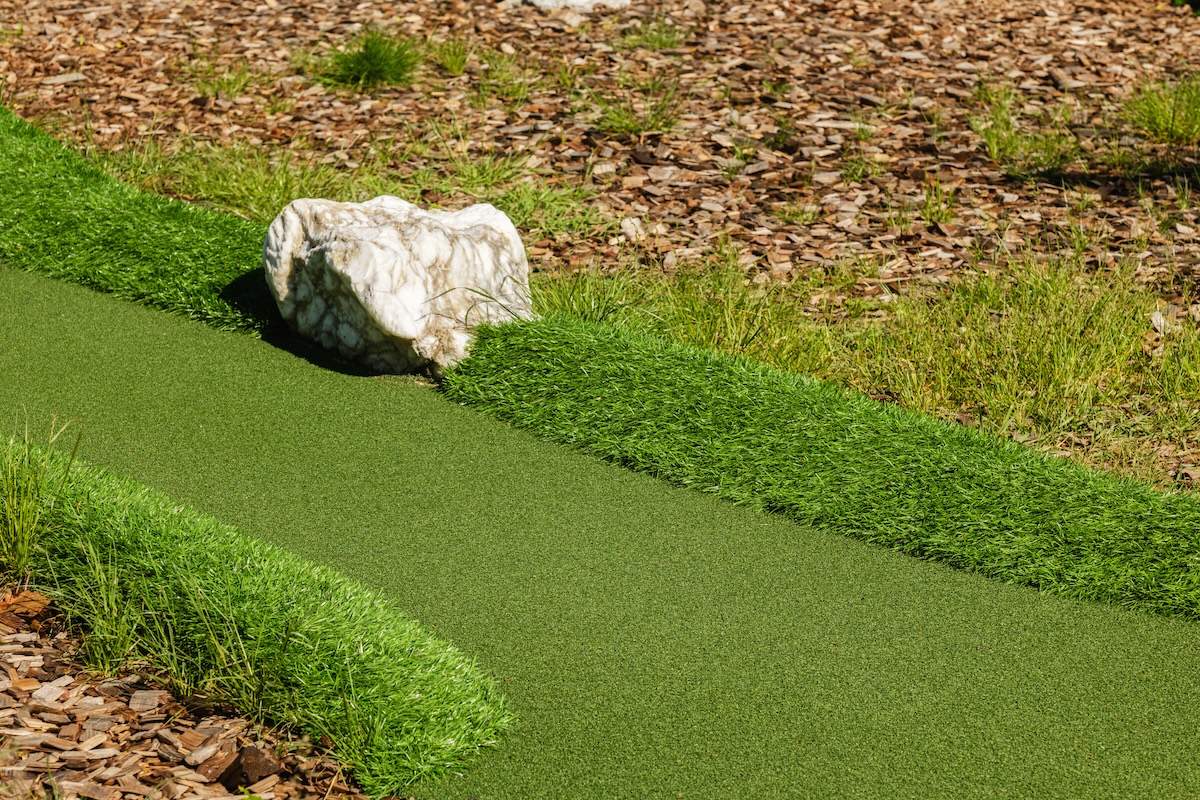
The considerations are mainly practical and aesthetic, rather than biological: how to make the boundary clean, how to keep natural grass from creeping into the turf, and how to match the two closely enough that the transition looks intentional rather than accidental. Naturally, choosing the most realistic looking artificial grass you can find helps a great deal, but there is more to get right in the installation to make it look polished and intentional.
Homeowners may choose this combination for a range of reasons:
- A shaded area under a tree in a spot where grass refuses to grow becomes usable with turf, while the sunny lawn stays natural.
- A high-traffic path or play area gets synthetic turf for durability while the surrounding yard keeps its natural look.
- A pet’s favorite corner gets easy-to-clean turf while the rest of the lawn stays as it is.
In each case, the goal is to solve a specific problem in one zone without converting the entire yard.
Let’s take a look at the example photo below. It is likely a major improvement from what was there to begin with, but there is no intentional-looking border between the two surfaces: the turf simply meets the natural grass with an open, undefined seam, which is exactly the kind of edge that lets grass and weeds creep into the turf over time, and allows the turf edge to lift.
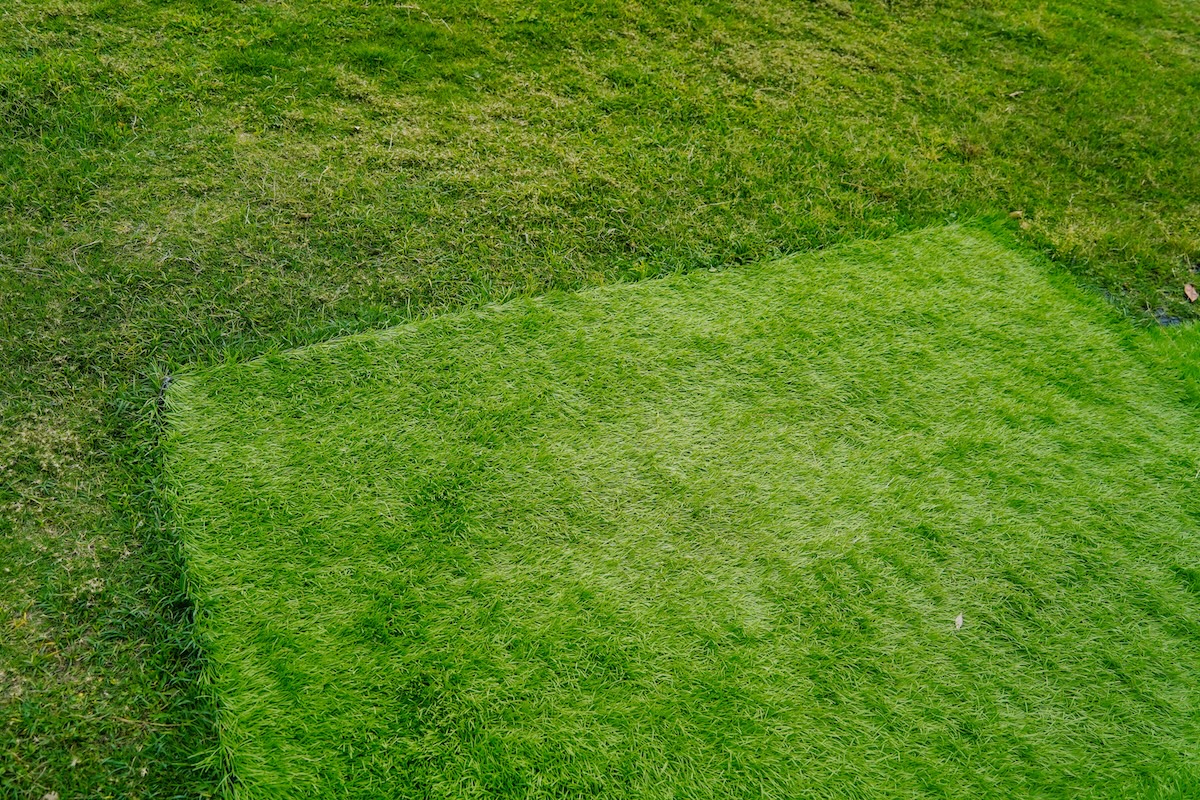
There is also no mowing strip along the boundary, so cutting the natural grass right up to the turf will be awkward and easy to botch. And the turf appears to sit slightly proud of the soil line rather than flush with it, a sign it may have been laid on grade rather than set into a properly excavated and compacted base. None of these things are especially difficult to get right, but the photo above shows what can happen when the border, the mow strip, and the base height aren’t planned from the start.
The installation pictured below is a good example of the combination done well. On the left, artificial turf runs in an even, beautiful green. And on the right, living grass shows the varied tone and texture of living grass. Rather than letting the two surfaces meet at a single open seam, this design separates them with a gravel bed and a defined hard edge, turning the transition into an intentional landscaping feature rather than an awkward boundary.
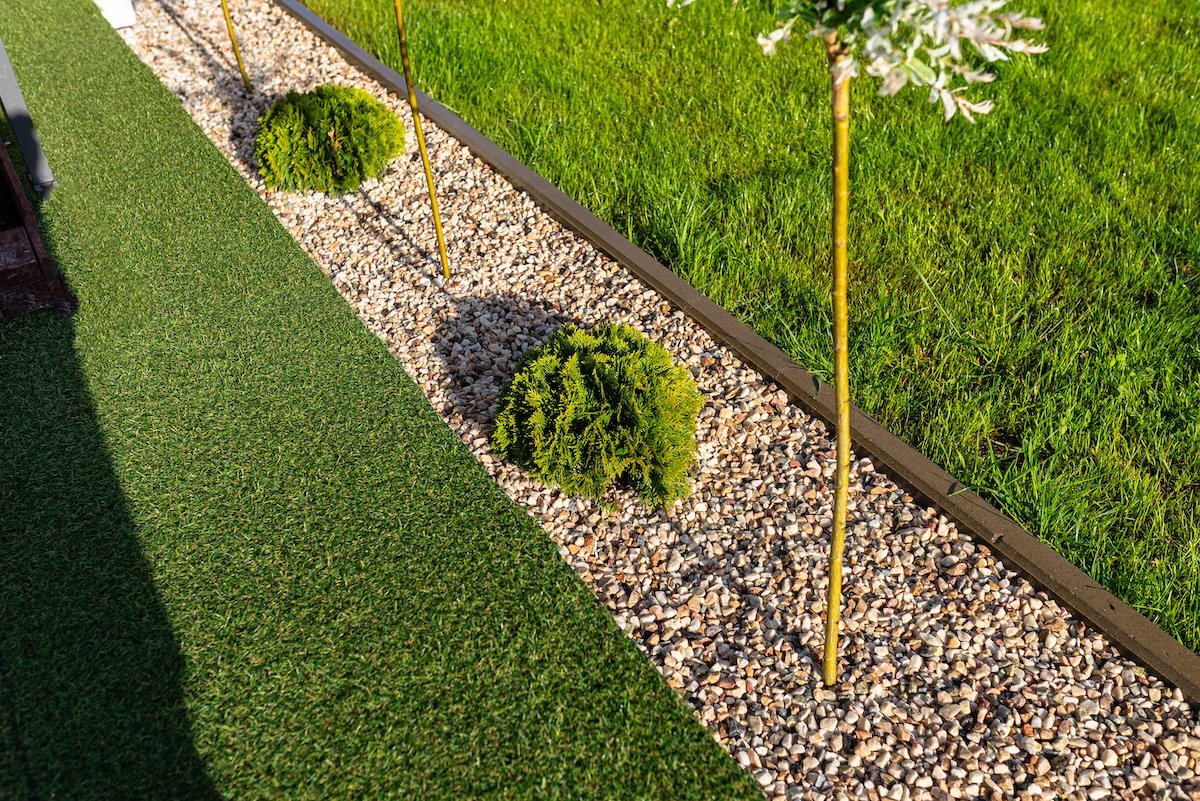
The decorative strip does work beyond looks: it acts as a physical buffer that keeps the natural grass from creeping into the turf, gives water a clear path to drain between the two surfaces, and creates a crisp visual line that reads as deliberate design.
The color match helps as well, with the turf green sitting close enough to the living lawn that the whole scene feels cohesive rather than mismatched. Worth noting that this shows the separated approach, where turf and grass are divided by a landscaped buffer, rather than the direct-adjacency approach where the two meet at a single clean seam.
Both approaches to mixing artificial grass and real grass are valid, and which one suits a yard depends on the look you are after, but the method pictured above is one of the easiest ways to get a clean, low-maintenance result that stays sharp over time.
Why Homeowners Combine the Two
The appeal of a mixed lawn comes down to putting each surface where it performs best. Natural grass has qualities synthetic turf cannot replicate: it is cool underfoot in summer, it supports soil ecology, and many people prefer its living character. Artificial turf has strengths natural grass cannot match in certain spots: it needs no water or mowing, it stays green year-round, and it holds up where natural grass struggles.
Combining them lets a yard use each where it makes the most sense:
- Deep shade. Areas beneath mature trees or on the north side of a house often receive too little sun for natural grass to establish. Turf stays green in shade that would leave a natural lawn thin and patchy.
- High-traffic zones. Paths worn into the lawn, play areas, and gathering spots take more wear than natural grass can recover from. Turf absorbs that traffic without developing bare patches.
- Pet areas. Dog runs and favorite corners that turn to mud or develop urine spots stay clean and consistent with turf, which rinses down easily.
- Slopes and hard-to-mow areas. Steep banks and awkward strips that are difficult or unsafe to mow are simpler to maintain as turf.
- Water-conscious landscaping. Reducing the natural lawn to the areas that thrive, and using turf elsewhere, cuts irrigation without giving up green space entirely.
The Main Challenges to Plan For
The combination works, but a few predictable issues separate a clean result from a messy one. Knowing them in advance is what allows the installation to account for each.
Color and texture matching
Natural grass shifts in color through the seasons, deep green in spring and summer, browner in heat or dormancy, while artificial turf holds one consistent shade year-round. The two will rarely match perfectly at every moment of the year, so the goal is choosing a turf whose color and blade style sit close enough to your natural lawn that the difference reads as natural variation rather than a jarring line. Turf with a mix of green tones and tan or brown thatch flecks tends to blend more convincingly than a flat, uniform green.
Height differences
Natural grass changes height constantly, tall before mowing, short after. Artificial turf stays at its fixed pile height. If the turf’s pile height is chosen to sit near the mid-range of your natural lawn’s mowed height, the two stay visually close through the mowing cycle. Turf that is much taller or shorter than the adjacent mowed grass makes the boundary stand out.
Grass creeping into the turf
This is the most common long-term maintenance issue. Natural grass spreads by rhizomes and stolons, underground and surface runners that can push under or through a poorly bordered edge and emerge in the turf.
Bermuda grass is especially aggressive this way. Without a proper barrier, blades of natural grass and weeds can work their way up along the turf edge and into the infill. A well-built border is the single most important defense against this.
Drainage across the boundary
Water needs to move off both surfaces without pooling at the seam. Artificial turf drains down through its backing into the base beneath it, while natural grass absorbs water into the soil. Where they meet, the grades need to be planned so water does not collect along the edge, saturate the natural lawn, or wash out the base under the turf. This is a bigger consideration on slopes and in heavy-rain regions.
Height of the finished surfaces
Artificial turf sits on a compacted aggregate base several inches deep. If not planned for, the finished turf surface can end up higher or lower than the adjacent soil and grass, creating a lip or a trench at the boundary. A clean installation sets the base depth so the turf’s finished height sits flush with the neighboring lawn.
How to Build a Clean Transition
The border between artificial and natural grass is where the whole project succeeds or fails. A well-constructed edge holds the turf in place, keeps natural grass from creeping in, manages water, and gives the eye a clean line. Several edging methods work, each suited to different looks and budgets.
| Edging method | How it works | Best for |
|---|---|---|
| Bender board | Flexible plastic or composite strip staked vertically along the edge, turf secured to it | Curved and straight borders; a clean, low-visibility line |
| Steel or aluminum edging | Rigid metal edging installed as a barrier between surfaces | Long, straight runs; strong root barrier |
| Paver or stone border | A row of pavers, bricks, or stone set between the turf and the lawn as a mowing strip | A decorative, defined transition that doubles as a mow strip |
| Trench and buried edge | Turf edge secured in a shallow trench and backfilled, hiding the seam | The most natural-looking, near-invisible transition |
| Timber or composite board | Wood or composite boards set on edge as a defined border | A visible, structured, modern-looking edge |
Whatever material is used, the border serves the same functions. It anchors the turf edge so it cannot lift or curl, it acts as a barrier that slows natural grass from spreading into the turf, and it creates a defined visual line that makes the whole transition look deliberate. A paver or stone mowing strip carries an added benefit: it gives the mower a wheel path, so natural grass right at the edge can be cut cleanly without the mower running onto the turf.
The mowing strip advantage
A hard border wide enough to serve as a mowing strip solves two problems at once. It defines the transition attractively, and it gives you a surface to run the mower’s wheels along so the natural grass can be trimmed right up to the edge without scalping the lawn or dragging the mower across the turf. A row of pavers set flush with the turf height, or a poured concrete mow curb, both work well for this. Without a mow strip, the strip of natural grass immediately beside the turf tends to be the hardest part of the lawn to cut cleanly.
Matching Artificial Turf to Your Natural Lawn
The closer the turf resembles the adjacent living grass, the more natural the combination looks. A few product characteristics drive how well the two blend.
Color and multi-tone blades. Natural lawns are never a single flat green. They contain lighter and darker blades, and often some tan or brown at the base. Turf products that blend several green shades with a tan or brown thatch layer read as far more lifelike next to real grass than a uniform green. Matching the dominant green of your turf to the dominant green of your lawn species matters most.
Pile height. Selecting a pile height near your natural lawn’s typical mowed height keeps the two surfaces close in profile. A lawn kept at two inches pairs better with a turf around that height than with a very short or very tall pile.
Blade shape and density. Different turf products mimic different grass types. Matching the general blade shape and density to your lawn species, a fine fescue versus a broad-bladed St. Augustine, for example, tightens the resemblance. A denser turf also tends to look more like a healthy, well-kept lawn.
A practical tip: Before committing, set a sample of the turf directly on your lawn in the spot where the two will meet, and look at it in different light through the day. Turf can read differently in bright midday sun than in the softer light of morning or late afternoon, and seeing a sample in place is the most reliable way to judge the match.
Installation Overview
Installing artificial turf beside an existing lawn follows the same core steps as any turf installation, with extra attention paid to the shared boundary. The general sequence:
Mark the boundary
Lay out the exact line where turf meets lawn, using a hose or marking paint for curves. This is the shape the border will follow, so it is worth getting right before any digging.
Excavate the turf area
Remove existing grass and soil from the turf zone to the depth needed for the base, typically three to four inches, so the finished turf will sit flush with the neighboring lawn.
Install the border
Set the chosen edging along the marked line. This barrier separates turf from lawn, holds the base in place, and forms the root barrier against creeping grass.
Build and compact the base
Add crushed aggregate, grade it for drainage, and compact it firmly. Proper grading here is what keeps water from pooling at the boundary with the lawn.
Lay, cut, and secure the turf
Roll out the turf, cut it to follow the border line precisely, and fasten it to the edging or anchor it along the boundary so the edge stays down.
Add infill and brush
Brush in the appropriate infill to weight the turf and support the blades, then brush the fibers upright. A clean final brushing along the border helps the edge blend into the adjacent grass.
The boundary-specific steps, marking the line, installing a proper border, grading for drainage at the seam, and setting the base depth for a flush finish, are what distinguish a turf-beside-lawn project from a standalone turf installation. Everything else follows standard turf installation practice.
Maintaining Both Surfaces Side by Side
One of the practical realities of a mixed lawn is that you are now maintaining two surfaces with different needs, in close proximity. The good news is that neither is difficult; they simply differ.
Keep grass clippings off the turf. When you mow the natural lawn, clippings thrown onto the turf should be blown or raked off. Left in place, organic matter breaks down in the turf fibers and can encourage weeds to sprout in the infill. Bagging clippings or directing the mower’s discharge away from the turf keeps this simple.
Watch the border for creeping grass. Even with a good barrier, check the edge periodically for natural grass or weeds trying to establish along the seam. Catching and pulling them early, before they root into the infill, keeps the transition clean. A light application of edging maintenance a few times a season is usually all it takes.
Rinse and brush the turf as usual. The synthetic side needs periodic rinsing to clear dust and debris and occasional brushing to keep the fibers upright, especially in high-traffic spots. This is standard turf care, unaffected by the adjacent lawn.
Mind overspray and runoff. Keep lawn fertilizers, weed killers, and heavy irrigation from running off the natural lawn onto or under the turf. A well-graded boundary handles most of this, but it is worth being mindful when applying lawn chemicals near the edge.
Keep the natural side healthy. A thick, well-kept natural lawn makes the whole combination look intentional. The contrast is most noticeable when the natural grass is patchy or struggling, so the usual lawn care, appropriate watering, mowing, and feeding, pays off visually right at the boundary.
Design Ideas for Mixing Artificial Turf and Natural Grass

Beyond solving problem areas, combining the two surfaces opens up some real and artificial grass landscaping design possibilities that neither achieves alone.
- Turf pathways through a natural lawn. A synthetic path that stays green and mud-free winds through a living lawn, giving a clean walking route without a paved look.
- A turf play or pet zone framed by lawn. A defined synthetic area for kids or dogs sits within the natural lawn, durable where it needs to be and green everywhere else.
- Turf under play equipment. A synthetic surface beneath a swing set or trampoline, where natural grass always wears out, blends into the surrounding lawn.
- Turf accents in tough spots. Narrow side yards, parkway strips, and shaded corners go synthetic while the main lawn stays natural, keeping every part of the yard green.
Frequently Asked Questions
Q: Can you put artificial grass next to real grass?
A: Yes. Artificial and natural grass can sit side by side in the same yard with no harm to either. The keys to a good result are a clean, well-built border between them, choosing a turf that matches the natural lawn in color and height, and grading the boundary so water drains properly. Handled well, the transition can look close to seamless.
Q: Will natural grass spread into the artificial turf?
A: It can if the border is not built to prevent it. Grasses that spread by runners, like Bermuda, are especially prone to creeping along or under a weak edge.
A proper barrier, such as steel edging, bender board, or a paver strip installed as a root barrier, stops most of this. Periodically checking the edge and pulling any grass or weeds that appear keeps the transition clean over time.
Q: How do I make the transition between artificial and real grass look natural?
A: Three things matter most: match the turf’s color and blade style to your lawn, choose a pile height near your lawn’s mowed height, and build a clean defined border. Multi-tone turf with some brown thatch blends better than a flat uniform green. A buried or trenched edge gives the most seamless look, while a paver or stone strip gives an attractive, intentional-looking transition that also serves as a mowing strip.
Q: Do the two surfaces need to be the same height?
A: They do not need to match exactly, but a finished turf surface set roughly flush with the natural lawn looks best and avoids a lip or trench at the seam. Because natural grass changes height as it grows and gets mowed, choosing a turf pile height near the mid-range of the mowed lawn keeps the two visually close throughout the mowing cycle.
Q: How do I mow natural grass right up against artificial turf?
A: A hard mowing strip along the border is the cleanest solution. A row of pavers or a concrete curb set flush between the turf and lawn gives the mower’s wheels a path, letting you cut the natural grass to the edge without scalping the lawn or running the mower onto the turf. Without a mow strip, a string trimmer can tidy the strip of grass closest to the turf.
Q: Will water pool where the turf meets the lawn?
A: Not if the boundary is graded correctly. Artificial turf drains through its backing into the base below, and the grade at the seam should be planned so water moves off both surfaces rather than collecting at the edge. This matters most on slopes and in areas with heavy rainfall, where drainage planning at the boundary deserves extra attention.
Q: Does artificial grass damage the natural grass next to it?
A: No. The turf itself does not harm adjacent natural grass. The main thing to watch is that the natural lawn’s roots and runners do not creep into the turf, and that lawn chemicals and clippings are kept off the synthetic side. Neither surface degrades the other.
Q: Can I install turf next to my lawn myself, or should I hire a professional?
A: Smaller, simple boundaries are within reach of a capable DIYer, particularly a straight edge on flat ground with a paver or bender-board border. Larger areas, curved boundaries, slopes, and situations with tricky drainage benefit from professional installation, since the base grading and border work at the seam are what determine whether the result looks clean and holds up over time.
Putting artificial grass next to real grass is a practical, popular way to get the best of both surfaces: durable, always-green turf where natural grass struggles, and a living lawn everywhere it thrives. The difference between a combination that looks accidental and one that looks intentional comes down to a well-built border, a turf matched thoughtfully to the natural lawn, and proper grading where the two meet. Get those right, and the two surfaces can look great together for many years to come.