Last Updated on January 22, 2026 by ReTurf
It’s common to see concrete specified under turf surfaces as a default, often at a cost around $6.00 per square foot. In many project plans, it’s treated as a necessary structural step. In most cases, it isn’t.
This happens most often with baseball training facilities, both indoor and outdoor. Hitting tunnels, pitching lanes, infield practice areas, hybrid training spaces. Somewhere in the planning process, concrete becomes the default assumption. Once that assumption is locked in, budgets tighten, compromises start, and the actual performance elements of the facility get trimmed back.
The reality is simpler, and far less expensive: A properly designed and constructed stone (aggregate) base is sufficient for the vast majority of synthetic turf installations, including most sports and training applications.
Concrete has its place, but that place is narrower than most people are led to believe. This article explains why pouring concrete may be unnecessary, when it may make sense, and how stone-base systems perform when they’re engineered and installed correctly.
Where Does The “Concrete Under Turf” Idea Come From?
In many baseball facilities, concrete gets specified simply because it’s familiar, not because it’s functionally required.
For general contractors and architects who don’t specialize in sports surfaces, a slab solves several unknowns at once: flatness, drainage assumptions, perceived durability, and liability comfort.
That mindset makes sense in traditional construction. It doesn’t always translate well to turf systems.
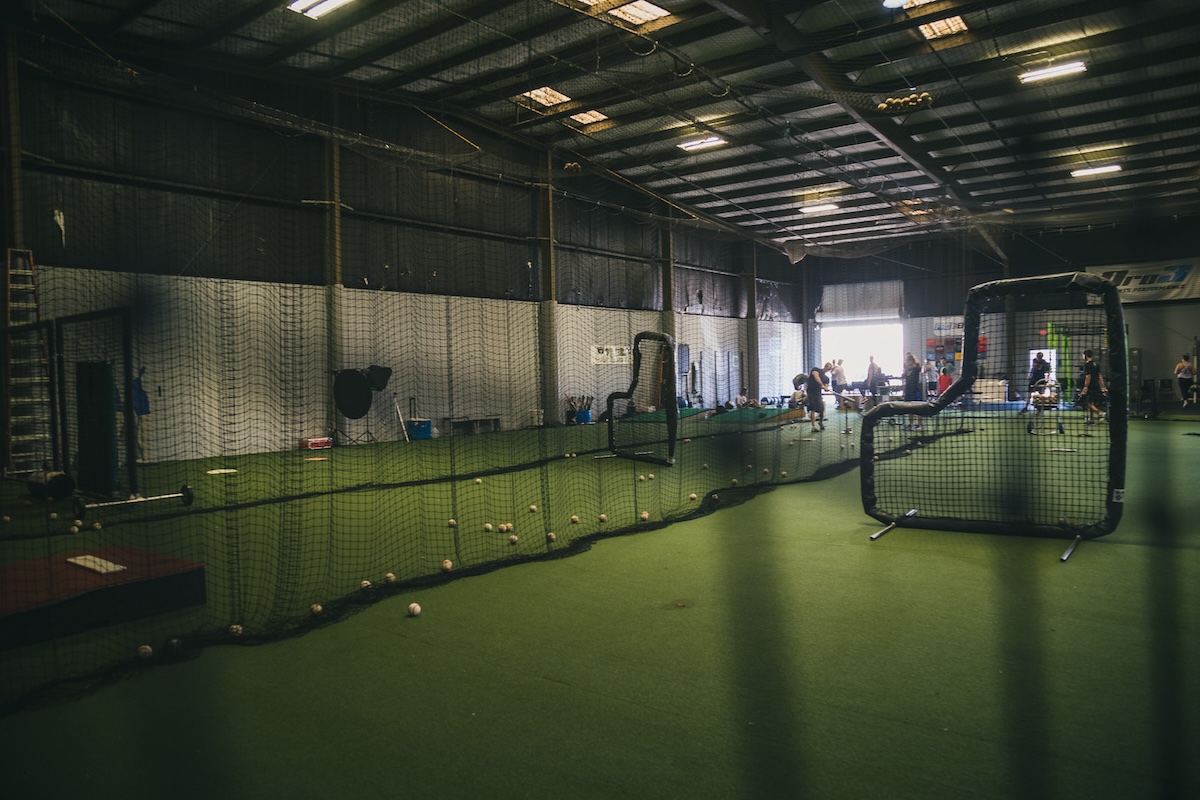
Sports turf behaves differently than finished flooring. It’s designed to work with vertical drainage, shock absorption layers, and controlled compaction.
When you introduce a non-permeable slab underneath, you’re changing how the entire system handles moisture, movement, and long-term wear.
Why a Stone Base Works for Most Turf Installations
A well-built stone base is a layered, engineered system designed to support load, manage water, and maintain surface stability over time. When installed correctly, a stone base provides:
- Load distribution that handles foot traffic, sleds, cages, and portable equipment
- Vertical drainage, which reduces moisture buildup and odor issues
- Surface forgiveness, helping with joint stress and fatigue
- Easier repair access, should sections ever need adjustment
For baseball training facilities in particular, these traits are important. Players are repeating movements in confined lanes. Subtle surface behavior affects traction, comfort, and long-term wear on the turf fibers. A compacted aggregate base with proper grading can often outperform concrete in these conditions.
Indoor vs Outdoor Baseball Facilities
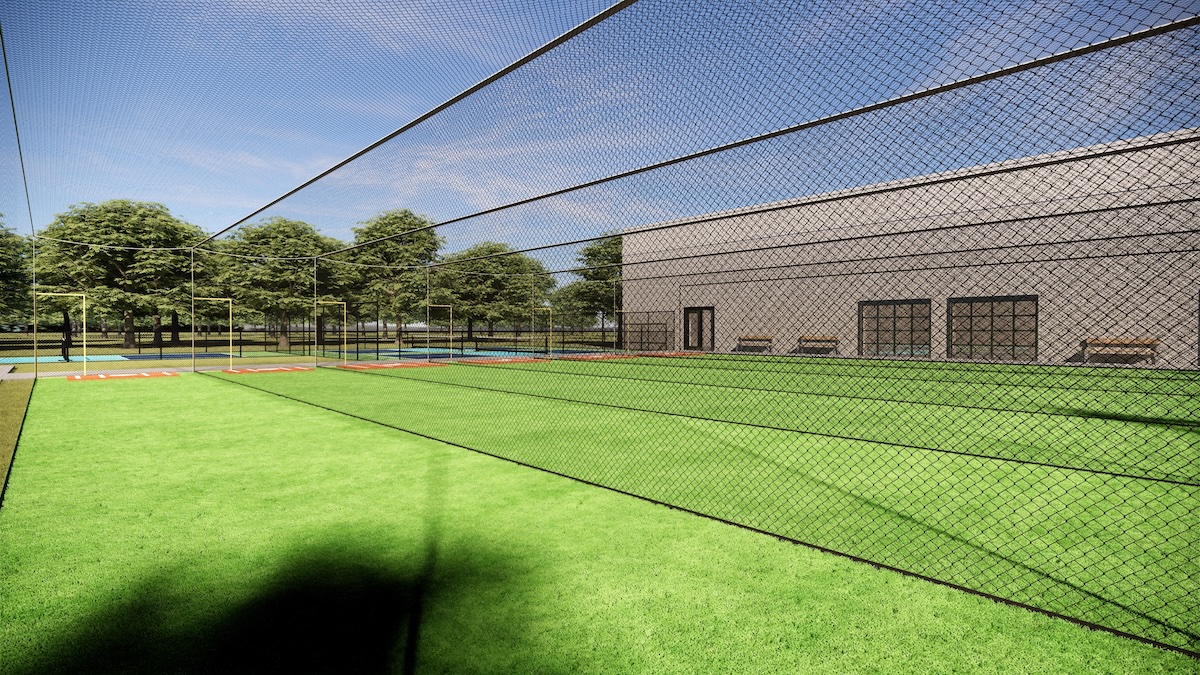
Outdoor baseball facilities rarely need concrete beneath turf areas. Properly engineered stone bases can support turf systems, while permanent structures and seating are typically carried by footings or foundations. From both a performance and drainage standpoint, stone is often the superior solution.
With indoor facilities, the absence of visible soil leads people to assume concrete is the only option. It isn’t. Indoor stone-base systems can work extremely well when the building envelope, moisture control, and grading are planned together.
Cost Considerations
At roughly $6.00 per square foot, pouring concrete adds up fast. That means a 10,000 sq. ft. training facility is looking at $60,000 before turf, padding, or installation even begins.
In practice, that same budget may deliver far more value when used for alternatives like:
- Higher-quality turf systems
- Shock pads or performance underlayments that reduce fatigue and joint stress over long training sessions
- Netting and containment, allowing the space to handle higher ball speeds and more flexible layouts
- Ball-tracking, pitching analysis, or video systems that directly improve instruction and athlete feedback
- Lighting upgrades that provide consistent coverage for both live training and camera-based tech
- Additional square footage, avoiding tight lanes and layout compromises caused by budget compression
Drainage Performance
Concrete slabs don’t drain. They shed water sideways or trap it if slopes are imperfect. In enclosed spaces, that moisture has nowhere to go.
Stone bases allow water to move vertically, away from the turf system. That reduces:
- Odor buildup
- Mold risk
- Adhesive failures
- Seaming stress
- Long-term fiber degradation
Structural Integrity Without a Slab
A common question is whether the building itself requires a concrete slab for structural reasons. In many steel-frame and pre-engineered buildings, the primary structure is designed to carry loads independently of the floor slab. In those cases, the slab functions as a finished floor rather than a load-bearing element.
That said, slabs can play secondary roles depending on the building design, code requirements, or equipment loads. Whether a slab is structurally required should always be confirmed explicitly rather than assumed by default.
This is where early coordination can make a big difference. When turf specialists, engineers, and builders align during design, stone-base turf systems are routinely approved and integrated without compromising structural or code requirements.
Concrete May Make Sense in Certain Situations
Note: This article is for general information only, and isn’t meant to advise or replace input from an engineer, architect, turf specialist, or other professional involved in your specific project.
There are situations where installing turf over concrete can be appropriate. These cases are less common than default design assumptions often suggest, but they do exist and should be evaluated during the planning phase.
Concrete may be appropriate in circumstances such as:
- Facilities designed to support frequent use of heavy rolling or wheeled equipment, where surface rigidity is required by the equipment manufacturer or building engineer
- Spaces intended to function as industrial or mixed-use areas, where turf is only one of several surface types
- Projects with extremely tight elevation or clearance requirements, where subgrade depth is limited by the structure or adjacent systems
- Sites with floodplain, high water table, or geotechnical constraints that restrict excavation or drainage design
- Turf systems specifically engineered for installation over concrete, including products that rely on adhesives, integrated drainage channels, or manufacturer-approved slab assemblies
Some turf products are explicitly designed to be installed over concrete and perform as intended when the entire system—base, drainage, adhesives, and surface—is planned around that condition. However, problems can arise when concrete is installed by default and the turf system is then treated as though it were designed for a traditional stone base.
The Bottom Line
ReTurf’s experience across indoor, outdoor, youth, and professional athletic training environments consistently points to the same conclusion: Pouring a concrete slab to go under turf is typically unnecessary, and a stone base is sufficient for almost any turf surface—if it’s properly designed and installed.