Last Updated on March 23, 2026 by ReTurf
There’s a moment most homeowners have, usually sometime in late spring, where they’re standing in their backyard holding a hose and staring at a patch of dead grass between the stepping stones and thinking: there has to be a better way.
Maybe it’s the weeds that keep pushing up between the pavers no matter how much you spray. Maybe it’s the muddy gap that turns into a slip hazard every time it rains.
Or maybe you’ve just seen one too many Instagram reels of some impossibly tidy backyard with lush green artificial turf snaking between clean concrete squares and understandably thought—yeah, I want that.
The good news is that installing artificial turf with pavers is one of the more achievable backyard upgrades out there. It’s not especially complicated, the results are dramatic, and it genuinely solves a real problem.
The less good news is that there’s a lot of half-baked advice floating around—the “just glue it down” school of thought, we’ll call it—that can lead to bubbling, peeling, and other headaches within a year.
So let’s do this properly. Here are some important tips to guide you through your synthetic turf and paver installation.
Artificial Grass & Paver Ideas
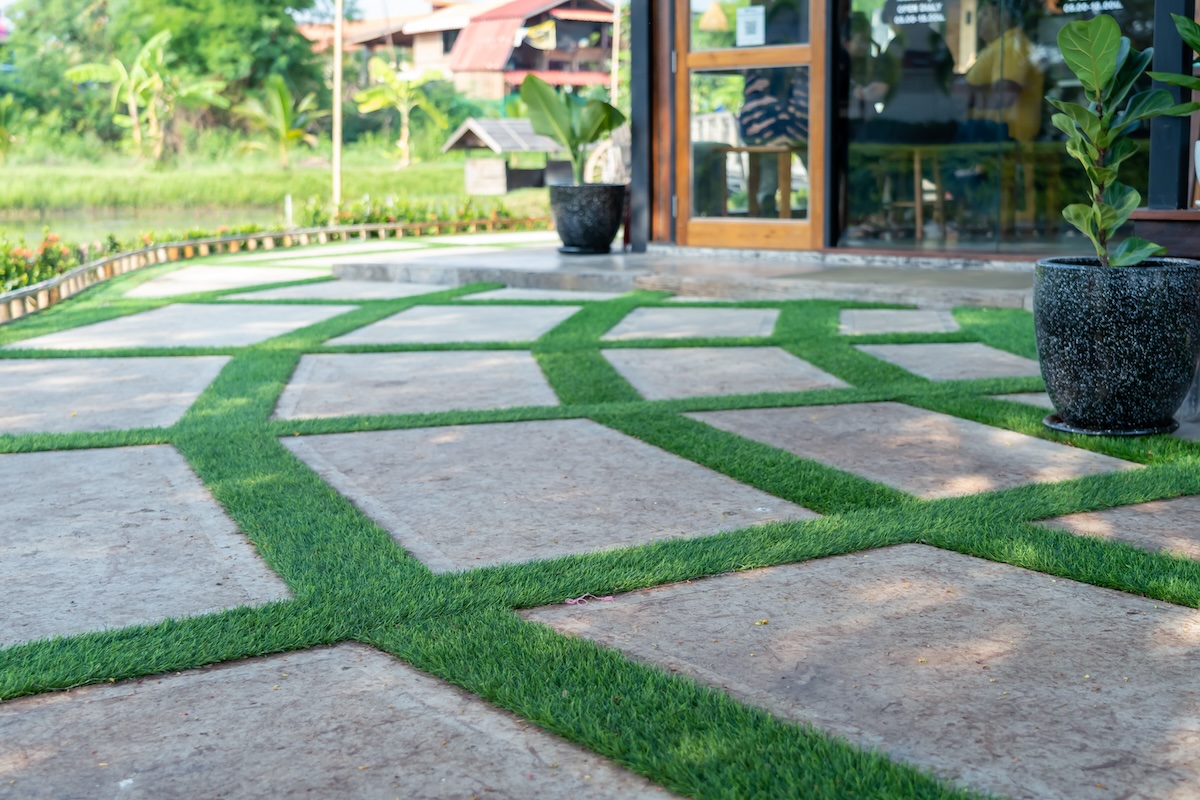
Before we get into installation, it helps to think through what you’re actually going for, because installing artificial grass between pavers can cover a lot of ground (literally).
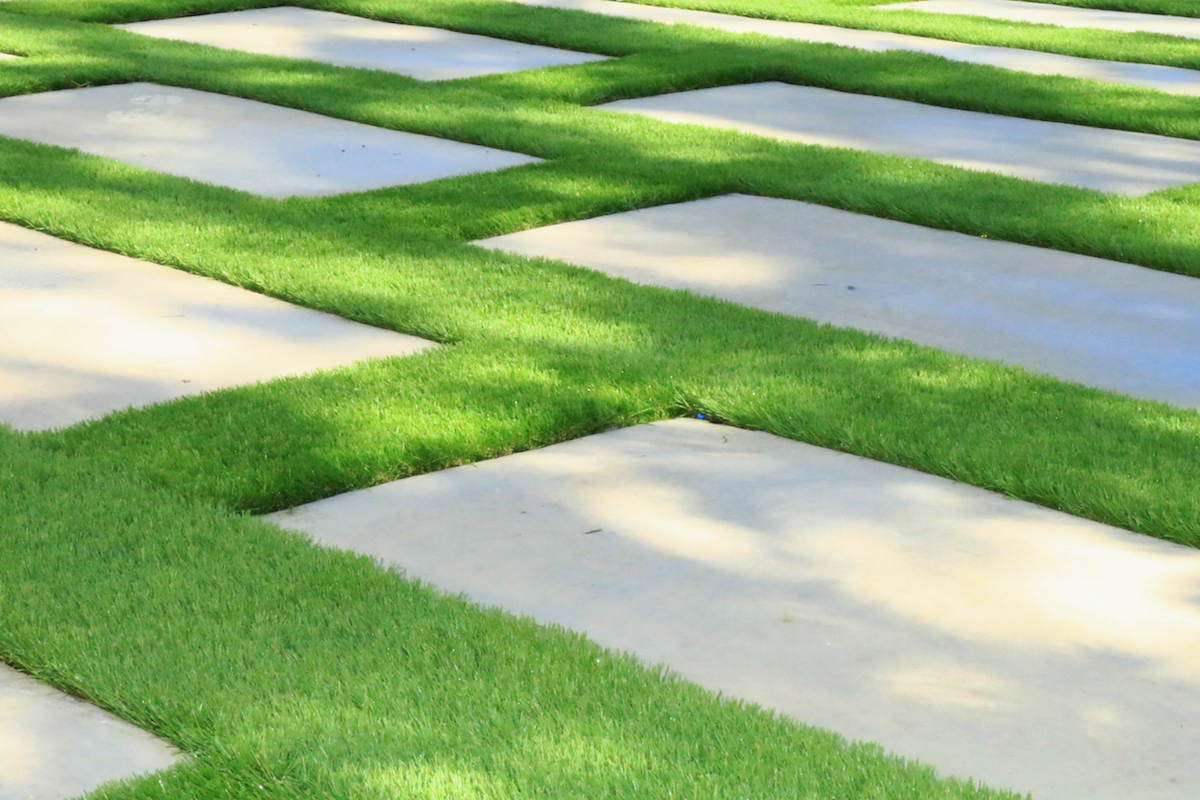
The classic stepping stone path. Individual flagstones or square pavers set into the ground with turf filling the gaps. This works beautifully for garden paths, side yards, and anywhere you want to suggest a route without making it feel like a sidewalk.
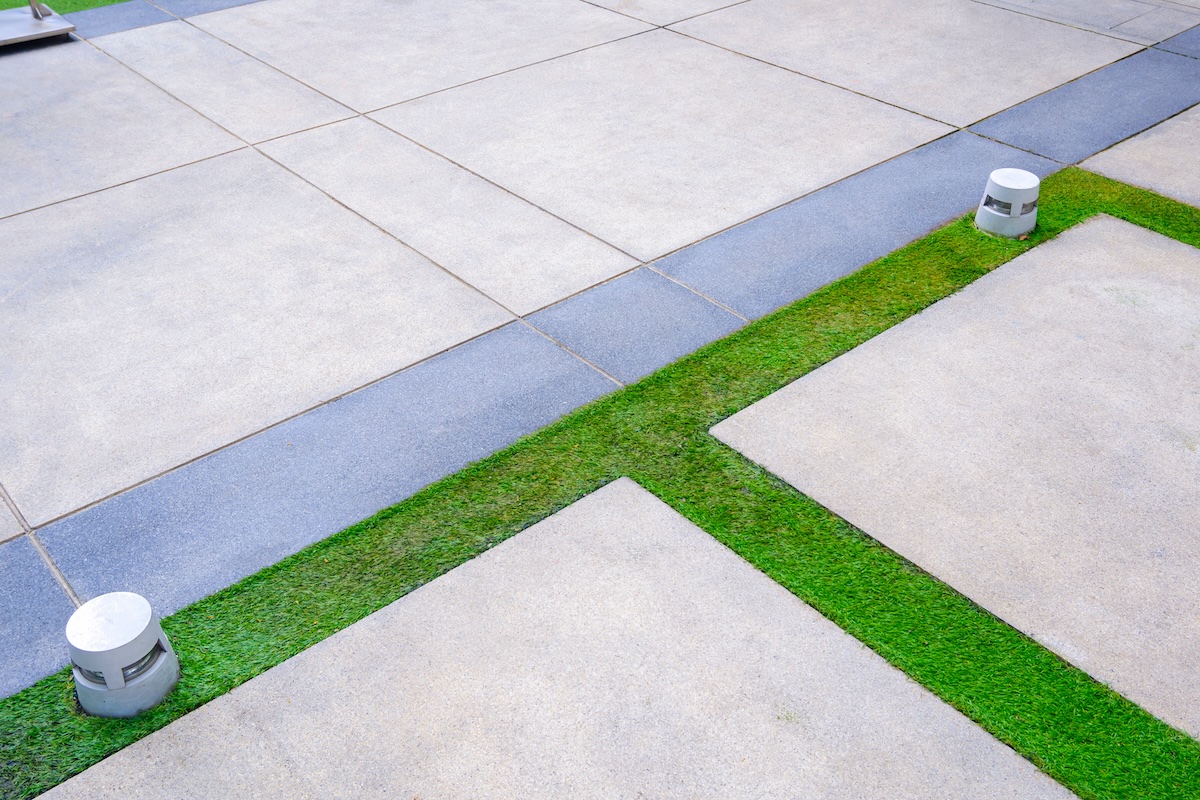
The grid patio. Large-format concrete pavers—24×24 or even bigger—laid in a grid pattern with uniform turf strips between them. This looks very modern and clean, especially in contemporary homes. The turf acts almost like grout lines, but soft and green.
The paver border with turf field. Here you flip the ratio: most of the space is turf, with pavers creating a defined border, a seating area, or a hardscape island. Great for larger yards where you want the warmth of grass but still need solid surfaces for furniture or a fire pit.
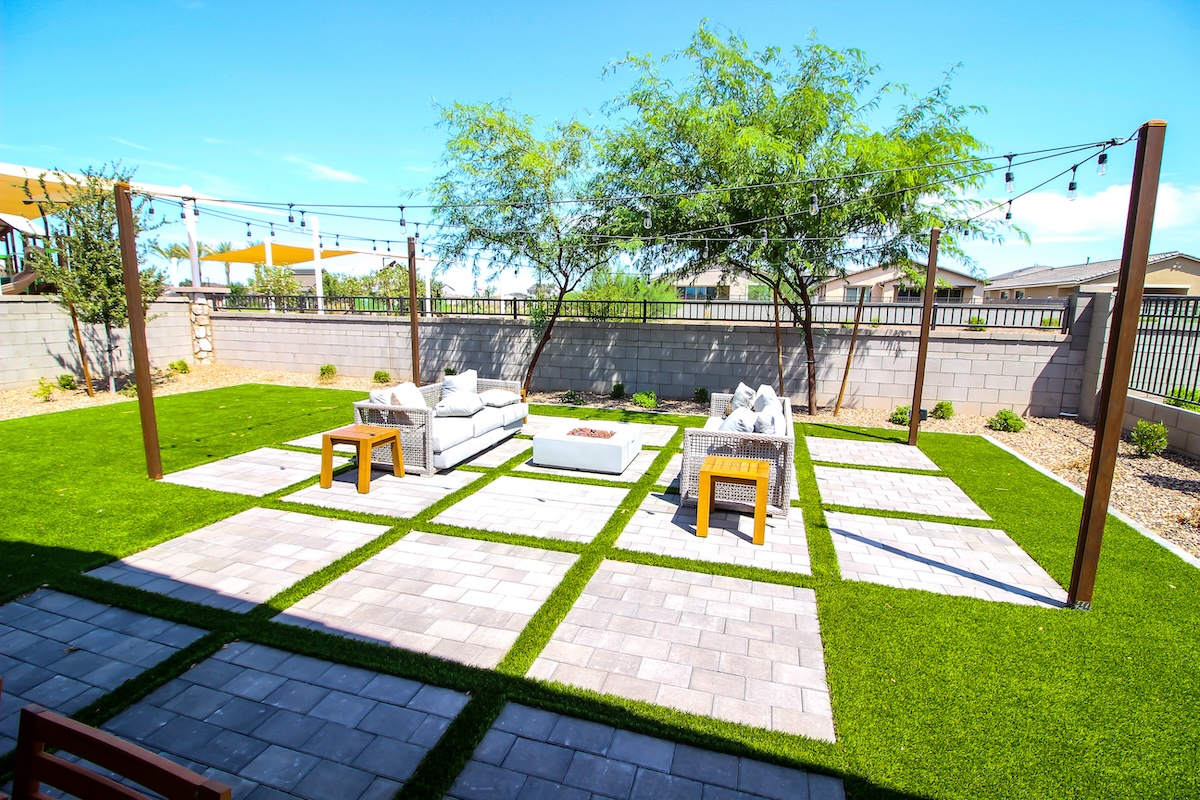
The putting green inset. Pavers on the perimeter, artificial turf in the middle—sometimes with subtle contouring. More of a specialty project, but wildly popular in Texas and Arizona climates where real grass is a constant battle.
Mixed-material steps and terracing. On sloped lots, pavers handle the structure and risers while turf fills the treads or landings. It softens what would otherwise be a very hard, utilitarian look.
Around a pool, large pavers with turf joints can help break up a broad deck and keep the space from reading like one uninterrupted slab of hardscape. This is a common choice in modern pool design, especially when the goal is a crisp geometric look with a little more softness built in.
Around a hot tub, turf and pavers can define the spa area without making it feel boxed in. A paver pad with turf surrounding it, or oversized slabs with turf joints nearby, can create a cleaner transition between the spa, the patio, and the rest of the yard.
The connecting path between the house and the pool or spa. Large stepping pads set into turf can make that walkway feel more relaxed and intentional than a long, fully paved strip, while still keeping the route practical and easy to navigate.
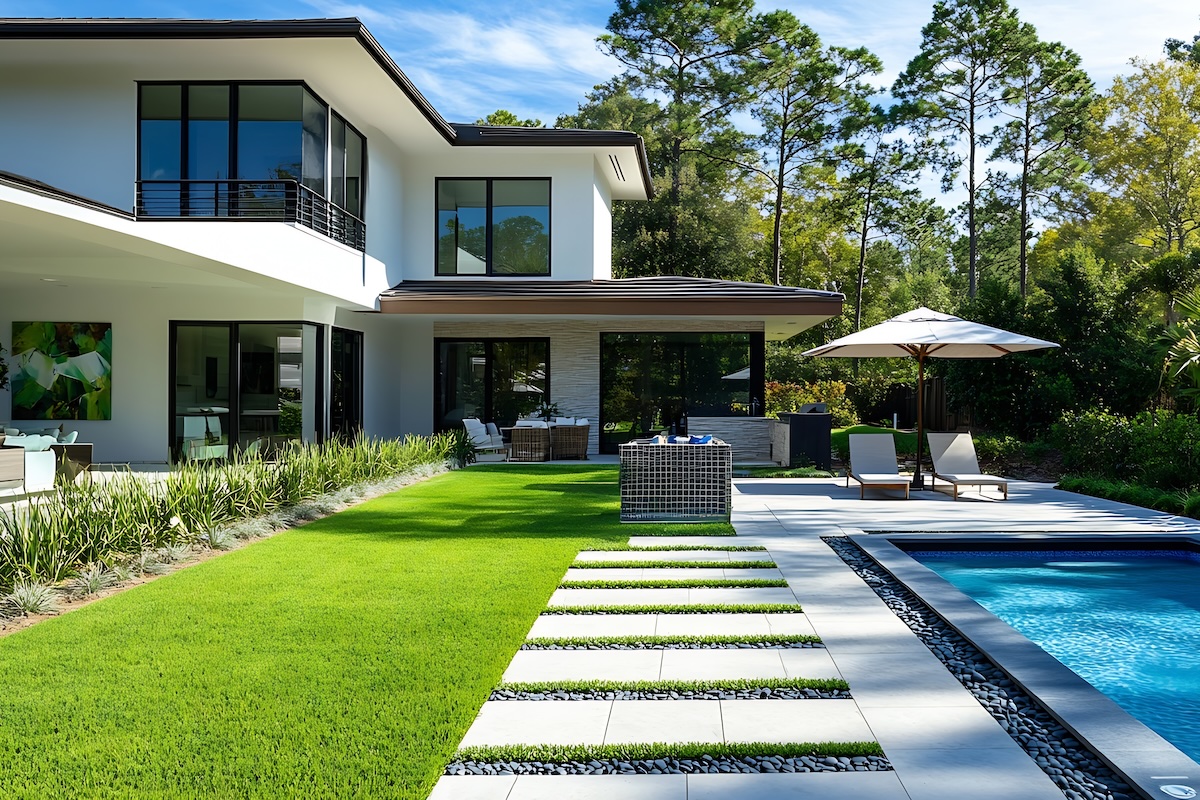
One design note worth mentioning: if you’re going the grid or stepping stone route, make sure your turf gaps are wide enough to actually be visible and meaningful. Generally the amount of artificial turf between pavers should be at least least 3 inches, and in many cases 4 to 6 inches can “read” better. Gaps narrower than that often just look like the turf didn’t quite reach.
How to Install Artificial Turf Between Pavers
A note on digging depth: this project involves excavating 3 to 4 inches—roughly the same depth as planting a shrub. That’s generally well above the depth of buried utilities, so a formal “call 811” warning typically isn’t warranted here. That said, if your project expands to include deeper work like fence posts, drainage trenching, or irrigation lines, call 811 and/or follow all appropriate local guidelines before you dig. It’s free, it takes two minutes, and it’s required by law in most states.
Step 1: Plan Your Layout and Order Materials
Measure the total area of turf you’ll need, accounting for the gaps between pavers. Order about 10–15% more than your measurement to allow for cuts and adjustments. Most artificial turf comes in 12- or 15-foot wide rolls, so factor that into your planning to minimize seams.
Step 2: Excavate the Area
Dig down about 3 to 4 inches below where you want the finished surface to sit. This gives you room for base material, a sand or decomposed granite setting layer, and the turf itself (which is typically about ¾ inch thick when properly installed).
If you’re installing pavers and turf together from scratch, plan for the top of your turf and the top of your pavers to be roughly flush—within about ¼ inch of each other. If the pavers sit significantly higher, you’ll have an edge that people trip on. If the turf sits higher, it’ll look puffy and awkward.
Step 3: Install the Base (Yes, You Need It—More on That Below)
Compact a layer of crushed aggregate base—typically 2 to 3 inches—over the excavated area. Compact it thoroughly with a plate compactor. This is the step most DIYers skip and later regret.
On top of the aggregate, add about ½ inch of coarse sand or decomposed granite as a leveling layer.
Step 4: Set Your Pavers
With your base compacted and leveled, set your pavers to their final position. Check for level frequently. Leave consistent gaps where the turf will go. Once pavers are set, tamp them firmly and check again.
Step 5: Cut and Fit the Turf
Roll out your turf and rough-cut it to fit the areas between pavers. Always cut from the back side using a sharp utility knife and a straight edge. Follow the backing, not the fibers—cut between rows of stitching to avoid cutting blades and creating a ragged edge.
Test-fit before any adhesive or fasteners go down. Turf should sit flat without bubbles and should be tight against the paver edges.
Step 6: Secure the Turf
See the next two sections for anchoring options in detail. For most installations between pavers, a combination of landscape staples along the edges and construction adhesive where turf meets paver is the most reliable approach.
Step 7: Add Infill
For most residential installations between pavers, a light application of silica sand infill (about ½ to 1 pound per square foot) helps the turf blades stand upright, adds weight to hold the turf in place, and improves drainage. Brush it in with a stiff broom and let the fibers settle.
Step 8: Brush the Fibers
Use a power broom or stiff-bristle push broom to brush the turf fibers against the grain—this makes them stand upright and gives the lawn its lush, finished appearance.
How to Anchor Turf Between Pavers
This is probably the most common question, and the answer depends a bit on your specific setup.
Landscape staples (galvanized nails/spikes): The workhorse of turf anchoring. U-shaped galvanized staples or nails are driven through the turf backing and into the base below at 4- to 6-inch intervals around the perimeter of each turf section and along any seams. They’re fast, inexpensive, effective, and—critically—removable if you ever need to adjust or replace the turf. Use 6-inch staples minimum to get enough bite into the base.
Construction adhesive along paver edges: Where turf meets a paver, a bead of polyurethane construction adhesive (like Loctite PL Premium or similar) creates a clean, secure bond at the edge. Apply it to the paver surface, press the turf down, and weight it for a few hours. This eliminates that subtle lifting that can happen at the paver-turf junction over time.
Bender board or turf edging: For longer straight runs, a piece of bender board (a flexible plastic or composite edging material) can be staked along the paver edge and the turf folded under and stapled to it. This creates a very clean edge and is particularly useful when the turf runs alongside a raised paver border.
Concrete anchors: In cases where the turf needs to attach directly to concrete—say, around a concrete patio perimeter—you can use concrete nail anchors or tapcon screws through a metal or plastic channel, with the turf tucked beneath. It’s more work but extremely secure.
For most installs: staples through the field, adhesive at the paver edges.
Can You Just Glue Artificial Turf Strips Between Concrete Pavers?
Technically yes. In practice, it depends on how long you want it to last and how much you care about the result.
Gluing turf directly to a concrete surface—running a bead of adhesive on the concrete and pressing the turf down—does work for a time, and plenty of people do it. For a small accent strip or a low-traffic area, you might not have any issues for several years.
But here are the problems that come up:
Drainage. Artificial turf needs somewhere for water to go. If you glue it flat against an impermeable concrete surface with no drainage path, you’ll get water sitting under the turf, which leads to mold, odor, and eventually turf failure. A proper installation always has a permeable base below the turf.
Adhesion failure over time. Most construction adhesives aren’t designed for the thermal cycling outdoor surfaces experience—hot Texas summers will expand and contract concrete significantly, and many adhesives eventually let go. You’ll start getting bubbling and edge lift after a few years, sometimes sooner.
No infill, no body. Turf glued flat to concrete with no base, no infill, and no ability to drain looks flat and artificial in the worst way. It also feels hard underfoot, because you’re essentially walking on a rug glued to concrete.
The verdict: If you’re doing a temporary install, a small decorative strip, or a truly low-budget situation, gluing directly to concrete is an option. If you want it to look good for more than a couple of years, go through the proper process. The extra work upfront is far less trouble than peeling up failed turf down the road.
Do You Need Paver Base for Turf?
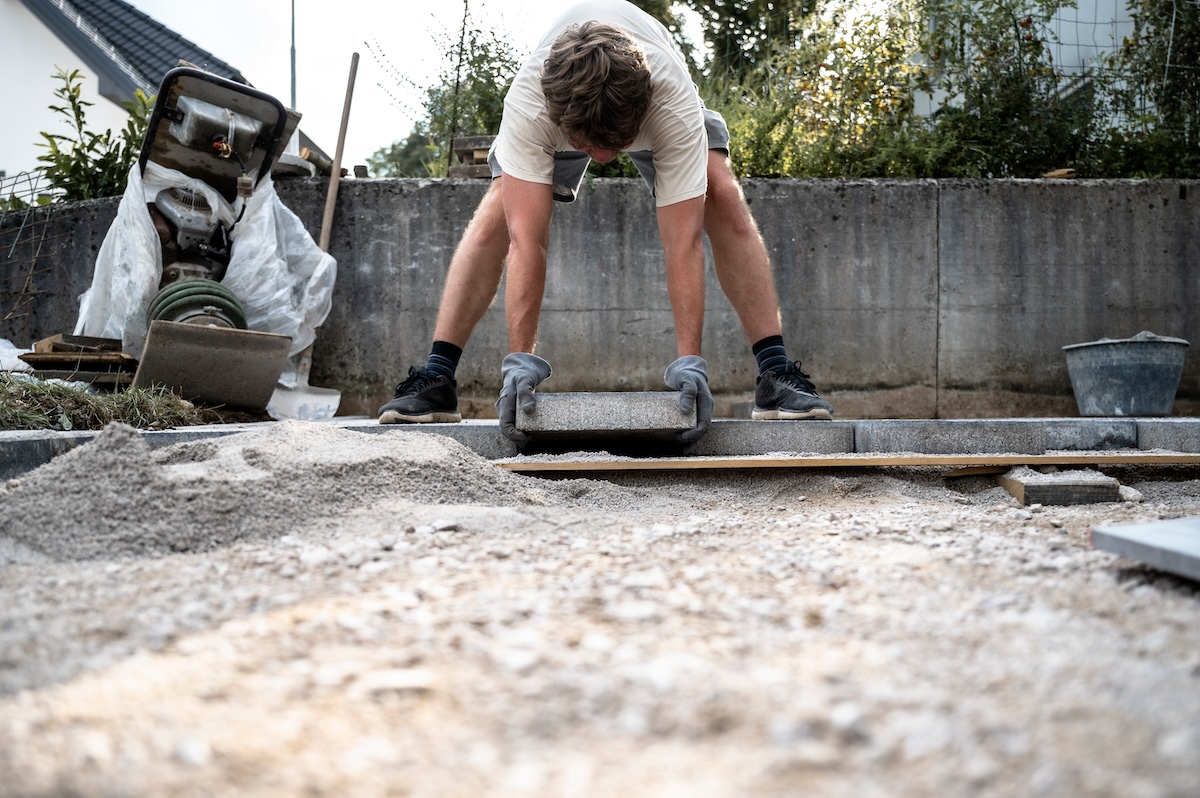
This question comes up a lot, and the honest answer is: yes, with rare exceptions.
The base layer—typically 2 to 3 inches of compacted crushed aggregate—serves several important functions.
Drainage. This is the big one. Artificial turf itself drains reasonably well through its permeable backing, but that water has to go somewhere. A compacted aggregate base provides the void space for water to drain through and disperse into the soil. Without it, you’re creating a bathtub. Pooling water under surfacing can lead to mold, unpleasant smells, and surface degradation.
Stability and levelness. Soil settles, especially after rain. An aggregate base, once properly compacted, provides a stable, uniform surface that resists settlement. Without it, your turf (and your pavers) will develop uneven low spots over time.
Anchoring. Landscape staples and other fasteners need something to bite into. Compacted aggregate holds fasteners much more reliably than raw soil.
The cases where you might skip a full base installation are limited: if you’re installing on an existing concrete or asphalt surface (in which case drainage needs to be addressed differently), or if you’re doing a very small, purely decorative accent in an area that never sees rain or irrigation. Outside of those situations, the base is not optional.
Some DIY guides suggest you can get away with compacted native soil plus a layer of sand. In certain conditions—well-draining sandy soil, mild climate, very light foot traffic—this can work. But the standard recommendation for any permanent installation is a proper aggregate base, and it’s the right call.
Is Artificial Turf Cheaper Than Pavers?
This is a common question, but the answer is genuinely nuanced. It depends on what you’re comparing, over what time period, and who’s doing the work.
Upfront Material Costs
Before we look at a combined installation, let’s look at artificial turf vs concrete pavers:
Artificial turf typically runs $2 to $8 per square foot for the turf material itself, depending on quality, pile height, and where you buy it. Budget products exist below that range; premium products go higher. Don’t forget to factor in infill ($0.50–$1.50/sq ft), base materials, and edging. Using artificial turf can be less expensive than pavers in typical installations, though there are many factors to consider.
Pavers vary enormously by material. Concrete pavers might run $3 to $8 per square foot or higher for materials only; while natural stone, brick, or porcelain can go $10 to $30 per square foot or more. And pavers also need a base, setting sand, and edging.
Now for a mixed turf-and-paver installation, material costs can often be comparable. You’re using less of each, so neither material completely dominates the budget. What drives cost the most is likely to be the ratio and the paver material choice.
Installation Costs
Professional turf installation typically runs $8 to $20 per square foot labor (on top of materials). Professional paver installation is often $15 to $25 per square foot for labor, sometimes more for complex patterns.
Turf installation is generally more DIY-friendly than pavers, particularly for small areas. Also note that cutting turf is forgiving in a way that cutting stone is not.
Long-Term Costs
Pavers, if properly installed, can last decades with minimal maintenance—occasional weed control and re-sanding, essentially. A quality artificial turf installation can also last 15 to 20 years, but eventually the turf will need to be replaced. The base and edging usually stay.
Real grass, if that’s the alternative you’re comparing against, involves ongoing water, fertilizer, mowing, and treatment costs that add up significantly over years—a figure that makes artificial turf look very cost-effective by year 5 or 6.
The Bottom Line
For a combined turf-and-paver installation, a cost comparison will depend heavily on paver choice. A full paver patio at similar quality is often at the higher end or beyond that range. Straight turf (no pavers) generally comes in lower than a full paver installation.
If budget is the primary concern, a well-executed artificial turf installation with simple concrete paver accents is usually more affordable than an all-paver patio at comparable quality.
A Few More Quick Tips
- Turf direction is important. Like many other types of surfacing, artificial turf has a “grain” of sorts. The fibers are stitched in rows, and they naturally lean one direction. When you look at it, the turf that has fibers leaning away from you looks fuller and greener; looking into the lean shows more backing. For pathways, lay the turf so the grain leans toward the most common viewing angle (usually from the house looking out). For seating areas, it matters less since you’re viewing from all sides.
- The surface of turf can get hot. In direct sun, artificial turf can get hotter than natural grass. Some premium turf products now have heat-reduction technology built in (using different fiber materials or infill), and it’s worth asking about if this is a concern for you.
- The edges are important. It’s the edges of an artificial turf installation (e.g. how cleanly the turf meets the paver, how well it stays down over time) that separate a polished install from one that always looks slightly undone. Take your time on the edges.
The Bottom Line
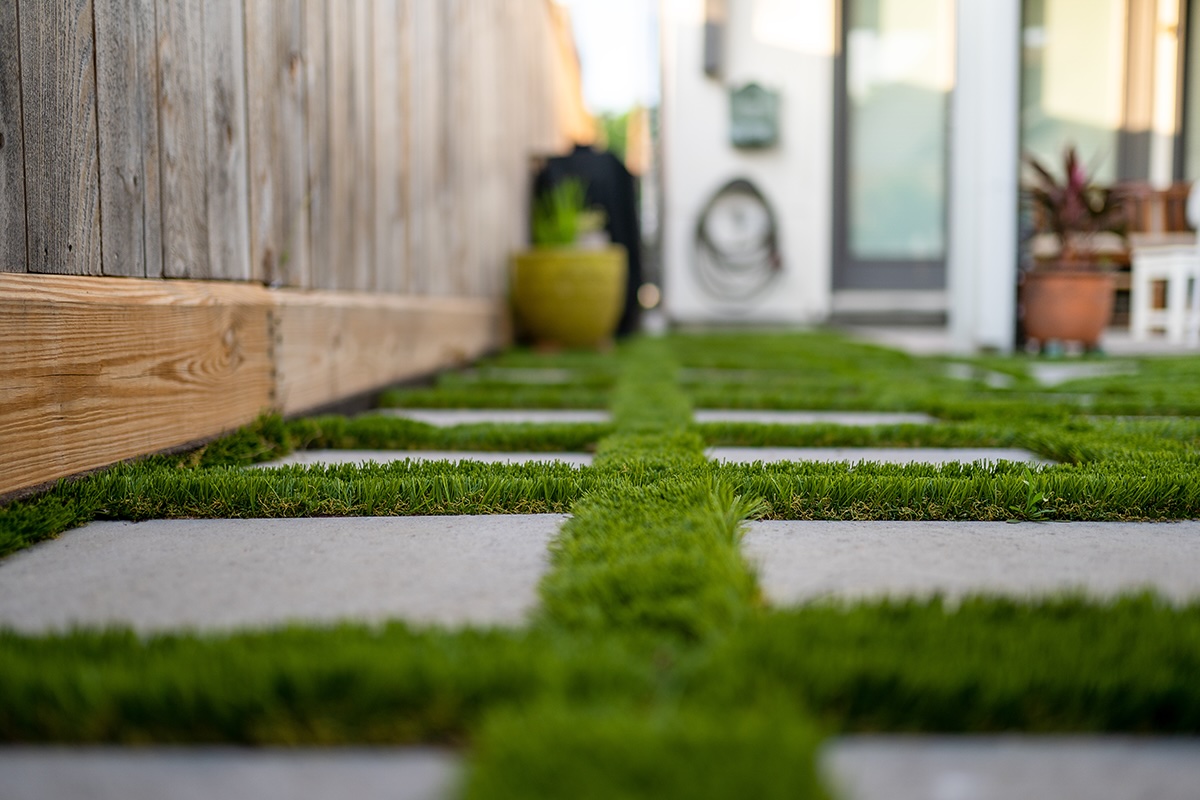
Combining artificial turf and pavers is a genuinely great solution for a lot of yards—low maintenance, year-round green, durable, and when done well, legitimately beautiful. The key is treating it like a real hardscape project: proper excavation, a real aggregate base, careful fitting, and solid anchoring at the edges.
Skip the shortcuts at the front end, and you can have a backyard that looks sharp for a decade, two decades, or longer—with almost nothing required from you besides an occasional rinse and a seasonal brushing.